Development in the Morongo Basin
Hello MBCA members and supporters! The Basin continues to be besieged by developments! This video clip taken from our annual meeting 6 months ago is already out of date as more development proposals and the changes by the current administration assault the integrity of the desert environment.
At the suggestion of our 3rd district supervisor Dawn Rowe (interviewed here) and with the coordination of MBCA, the senior leadership of Land Use Services (LUS) visited the Morongo Basin in March. LUS participants in the meeting included the Director and Assistant Director of LUS, Head of Development Services, Senior Building official, and the Chief of Code Enforcement.
MBCA board members and members of the Conservation Community as well as concerned individuals from throughout the Basin attended. The desire for improved notification of development proposals was a common issue expressed by the participants. The lack of a Municipal Advisory Committee (MAC) has hindered adequate notification. A telling example of the poor notification procedure is the lack of notification by LUS or, for that matter any elected County Official, when State Highway 247 became a CalTrans Scenic Highway. Following the in-person meeting a field trip was conducted to illustrate real world examples of the concerns. Examples included: unneeded scraping of intact desert encouraging invasive species and creating dust, the use of STRs as de-facto Boutique hotels, the Small Tract Act large parcel sizes typical in the Basin, as well as the prevalence of unimproved dirt roads.
LUS expressed a genuine desire to improve their knowledge and relationship with the Community that has been lost with the turnover of LUS staff in recent years.
Not withstanding the sentiments expressed by LUS, the pressure for more development continues with insufficient consideration of environmental consequences. Examples can be found with the recent recommendations for Mitigated Negative Declarations (MND) for the Lovemore Ranch development (appealed by MBCA), the Cactus Club Hotel, the Pipes Canyon Subdivision, and the Mercury Dry Camp (being appealed to the Board of Supervisors on August 4), as well as others. Recommendations for MNDs are inappropriate not only for adverse effects that have not been sufficiently analyzed, but also for the cumulative impacts of these developments as a whole within the Basin.
The County Wide Plan (CWP) and Business Plan adopted by the Board of Supervisors in 2020 is predicated on an Environmental Analysis that assumes limited growth in the high desert over the 20-year life of the plans. Within the Business Plan is an implementation schedule that is not being adhered to. This limited growth assumption is not supported by the policies and procedures of LUS where development is permitted and encouraged in the grab-bag of allowed uses in Rural Living (RL) zoned land. Most of the land the high desert is RL!
The environmental analyses for projects must consider the rapidly warming climate and precipitous decline in wildlife. The standards on which MNDs may have been recommended in the past are not applicable to today. MBCA urges the County to respect and incorporate the extensive scientific studies and data bases to protect and foster the unique and diverse ecosystem of the high desert, while encouraging appropriate development that supports the local economy.
ATTEND the Appeal of Mercury Dry Camp Project on August 4
An appeal has been filed challenging the approval of a Conditional Use Permit by the Planning Commission for the Mercury Dry Camp within the Homestead Valley Community. This campground project consists of 12 ‘Dry’ camp sites on a 7.5-acre site in the vicinity of Border and Reche Roads. The description of this development as a Dry Camp belies the incompatibility and impact of this development within the community.
The project site has been nearly completely scraped with some Creosote set afire by recent campers and with many of the native plants destroyed. The construction of a campground - a commercial enterprise, using the loophole of an allowed use in residential zoning exemplifies the disconnect of LUS and the CWP described above. While this development does not include the construction of improvements beyond shade structures, the intensity of use of the site has the potential to be significant. Issues that are unresolved and incompatible within the Community include:
-
The operation of a commercial business within a residential zoned area is inherently incompatible!
-
The campground lacks onsite supervision! This lack of supervision makes compliance with rules and regulations less likely with the potential for impact to the local community and increased calls for code enforcement, fire protection and law enforcement resources.
-
The rules and regulations state "No dumping of dirty water or other waste byproducts" and allude to "designated waste disposal areas". These areas have not been identified.
-
The project description calls for minor grading while the site plan states grading is ‘Not Applicable’. The photos of the site show tracks from recent grading equipment, and the satellite image shows a site that has been ravaged and nearly completely stripped of native plants. The condition of the site does not engender confidence in careful operation of the campground in the future.
- There is no means to limit the number of occupants of a campsite (see above re: supervision).
-
There is no means of controlling noise or light trespass from the campground. Unlike urban areas, noise and light can have adverse effects on neighboring properties miles away. Unshielded lighting may be utilized by campers creating Light Trespass. See above re: increased calls for code enforcement.
-
Noise monitoring is to be provided, however the means to do so has not been defined. See above re: increased calls for code enforcement.
-
No power will be provided to the site. The means of providing power for gates and an agreed-upon system of noise monitoring has not been identified. There are no limitations on the use of portable generators. See above re: noise and calls for code enforcement.
-
The project description states: ‘Fire extinguishers and first aid kits are to be provided in case of emergency’. There being no on-site management just the presence of the resources will not provide timely support required for this remote site. See above re: onsite supervision.
-
The use of the 2,500-gallon water irrigation tank has not been identified. Will it be used for new plantings? How would the water be delivered to plants? Where and how often will the tank be re-filled?
-
The fencing of the site with wooden fencing will deteriorate in a short time in the desert sun. The fencing will NOT serve to control noise or light trespass. The fencing WILL obstruct movement of wildlife.
-
The environmental analysis for the project does not include analysis for Vehicle Miles Travelled or Green House Gas Emissions for water or wastewater services.
-
The effects on health and air quality from the dust created by traffic on the entire unpaved site have not been acknowledged or addressed.
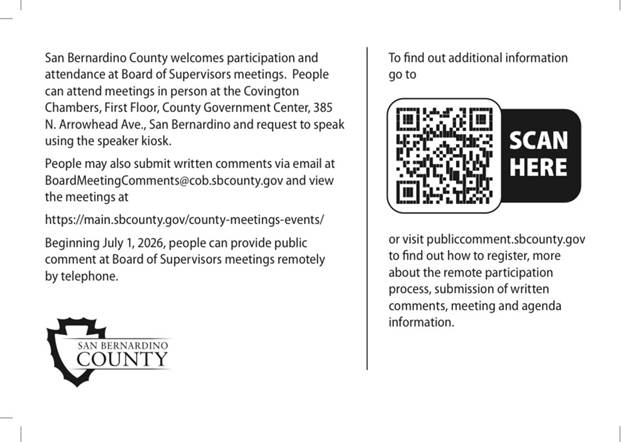
With the enactment of SB-707 requiring access for members of the public to attend public meetings via a 2-way telephonic service, the County has chosen to eliminate providing a video conferencing option and is relying on telephone only. While this new legislation does mandate public meetings be available by audio, it diminishes the ability of our elected representatives to see and hear from their constituents in this, the largest County in the country.
As with all cases heard by the Board, appearance in person is preferred, however we encourage participation in any way possible in support of this appeal. This appeal offers an opportunity to speak out against inappropriately sited development in the Basin.
When:
August 4, 2026, at 10:00
Where:
San Bernardino County Government Center
385 N Arrowhead Ave
San Bernardino, California 92415
The upcoming Supervisors meeting will mark the first time the revised public interface will be utilized by the Board. Use this link to register to make a comment:
https://publiccomment.sbcounty.gov/#Information-Regarding-Public-Participation.
Renewable Energy in San Bernardino County
During the April 7 meeting, the San Bernardino County Board of Supervisors received a presentation on a possible revision to the Renewable Energy and Conservation Element (RECE) of the County Wide plan. The revision would potentially expand the area where utility scale renewable energy projects could be located. Video of the hearing can be seen here beginning at 18:00 minutes. Subsequently at their June 23 meeting an Energy Ad Hoc committee was authorized to be formed. Video here at 3:15.
In 2018, after extensive public input and with compelling arguments by the late Paul Smith, the Planning Commission voted to adopt a limitation of utility scale projects within RL zoned lands and within Community Plan areas. The potential revision to RECE could revise this limitation at the expense of rural communities.
Mentioned in the discussions is the possible sale of Federal land for renewables and the construction of nuclear energy plants. Sale of Federal lands would require careful study which appears to be unlikely with this current administration. Proposals for auctioning off BLM land are being considered as described in this article in the Desert Trumpet.
Inappropriately sited renewable energy projects have the potential to create serious health issues for communities if projects are located on dust-prone soils. The residents of Boron are being inundated with dust from the Aratina project with associated asthma attacks and at least one case of Valley Fever reported! This project in Kern County was approved without a source of water and directly abuts San Bernardino County. This film by Casey Kiernan documents how an inappropriately sited project can have terrible effects.
Example of inappropriate renewable projects include the 1800-acre+ Sienna Solar project (unsuccessfully appealed by MBCA) approved despite the potential to bury Lucerne Valley in dust. We have become aware of other proposals including a 5,000 acre project in Johnson Valley that would destroy a scenic section of Highway 247.
Federal Attacks on Environmental Protections
The current administration is continuing its attack on long standing environmental protections. Of particular interest to our desert is the recent decision to allow The Cadiz Company to utilize a former gas pipeline for extracting water from the Cadiz aquifer without having to perform additional environmental analysis.
MBCA supports our conservation partners in tracking the many assaults on our environment including the proposed Music Mine and the recission of the Roadless Rule on many Federal Lands. The National Parks Conservation Association (NPCA) and the Mojave Desert Land Trust (MDLT) are hosting a Public Lands Happy Hour on August 6 at Mas O Menos in Joshua Tree from 5:30 to 7:30pm to bring together the conservation community and discuss on-going issues.
Attacks on California Environmental Quality Act
CEQA is under attack with Proposition 45 on this November’s ballot. The Proposition, if passed, would lessen environmental restrictions and give certain projects a ‘pass’ on any environmental review. The Power in Nature Coalition is hosting a webinar on this important measure on August 12 at 7:00 pm.
Good News! Balcony Solar Advances in California
California Senate Bill 868 that would allow the use of plug-in solar has cleared the Senate and an Assembly committee! It now goes before the full legislature.
This technology, already widely used in other states and countries, would give consumers the ability to simply plug a solar panel into an outlet and generate electricity for home use. With the plunging cost of solar this could offer a means to reduce the electric bill!
UCR Climate Stewards Course
This course offers an opportunity to become an effective participant in communicating and supporting local resilience and community integrity in our changing climate. An introductory overview is being offered on August 1 at 11:00 am and a second session is offered on August 19 at 6:00 pm. Those interested in participating in the course after attending one of the information sessions may contact MBCA at [email protected] for potential financial support.
Volunteer to support MBCA in our Adopt-a-Highway
Interested in supporting MBCA and helping keep the desert clean? Volunteer as we keep a section of Twentynine Palms Highway free of trash and litter. Email [email protected] to receive information on how you can participate.
Thanks for your on-going attention and support for our desert environment during these difficult times!



Showing 1 reaction
Sign in with
Facebook Twitter